
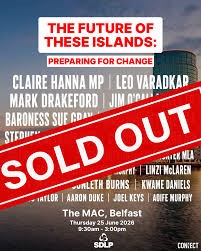
On the 25th of June 2026, I attended The Future of These Islands: Preparing for Change, a shindig organised by the SDLP. Let me start by saying I went in with low expectations, and they were fully met. The crowd were largely old Humeite SDLP members who, as expected, waxed lyrical about the opening two political panels and seemed to confuse political, economic, and geopolitical insight with political BS and platitudes. It was like a Mississippi Southern Baptists evangelical gathering, a hallelujah sell-out. The panellists included Leo Varadkar, Jim O’Callaghan, Sue Grey, Matthew O’Toole, and Clare Hanna, Unionist Ian Marshall, Mark Drakeford, former Labour leader in Wales, and Scottish Minister for Europe, External Affairs and Energy Stephen Gethins. Ian Marshall came to defend the political status quo and said the most memorable one-liner of the morning: “ Unionists cannot be at the table if their future is on the table.” The problem with that is that Unionists have not voluntarily seen the need for that bit of furniture since 1921. The two Social Democrat and Labour Party members, O’Toole and Hanna, to no real surprise, never invoked the word class or redistribution in their tree-hugging political analysis. They also showed their ignorance about the impact of AI on the future of work and on social cohesion in a rapidly changing geopolitical world. The SDLP, in other words, Matthew and Claire supported the creation of the Orwellian Office of Identity and Cultural Expression, further underpinning our obsession with identity politics. Neither of them supported the introduction of water rates urgently needed to upgrade our crumbling water infrastructure and build new houses. Claire waxed lyrical about this mythical new Ireland and the appetite for change. What she really meant was the SDLP’s desire to compete with the rhetoric of Ireland’s Future, who were equally uninspiring and lacked proper analysis and vision. She talked about the status quo not delivering, though her party were complicit in that, and now Matthew tries to sell electoral failure and being in opposition as a political virtue. She also used the term “reconciled Ireland.” Well, I think we need to do a better job up here before we can talk about a reconciled 32. Good luck with that, as our political and governing system has been embalmed with an oxymoronic mandatory coalition. Claire rightly said that the Brexit vote to leave was based on misinformation, and in the case of the debate around Irish unity, we should learn from that. For example, the cost of public sector pay parity will be €4 billion. The Republic spends 27% more per capita on healthcare than we in Northern Ireland and has one civil servant per 110 of the population, whereas we have 1 for every 70. I will finish with two things: nearly 60% of Northern Ireland’s GDP comes from public spending, and 27% of Northern Ireland’s workforce is employed in the public sector; in Ireland, it is 35% and 15%, respectively. Maybe the SDLP elected representative needs to talk to Professor John Doyle, Paul Gosling, and I am happy to chip in as a real social democrat.
Matthew also waxed on about the 1998 agreement, multilateralism, human rights and liberal democracy, but seemed to have no understanding of the failure of Hayekian Neo liberal free market economics, which introduced terms like trickle-down economics, shareholder tyranny and offshoring, where the benefits of growth went disproportionately up to the rentier class as opposed to the wage-earning working class. Neither he nor Claire ever mentioned redistribution as part of an all-Ireland economic model. Matthew and Jim O’Callaghan talked about Ireland’s pivotal role in the EU but again did seem to be ignorant of its role in a declining Europe which cannot defend itself against a country that is ranked in the 80’s in terms of GDP per capita. They also failed to recognise that Europe’s future is currently at the behest of Artificial Intelligence US, with no significant European player in the digital space. This has manifested itself in Europe’s GDP as a percentage of global GDP falling from 25% in 2000 to 16% in 2025 % largely as a consequence of China becoming a member of the WTO in 2001.
Leo Varadkar was somewhat incoherent, highlighting what he saw as some useful equivalents of the past. He did refer to the rise of the populist far right in Europe, but his diagnosis of why was missing.
Jim talked about Irish independence being a success as opposed to the 6 counties. Well, let’s not forget Europe’s investment in the old Ireland and how Ireland gamed the international tax regime to attract FDI and let’s not forget T.K. Whitaker, the architect of the Republic of Ireland’s economic transformation in the 1960s and Ireland’s dramatic GDP growth called Leprechaun economics by Nobel prize-winning economists Paul Krugman. Ireland’s FDI stock is some €1.3 billion, which is 255% of its GDP. He said that we could keep the PSNI and Stormont in a new Ireland, in other words, a pig with lipstick, and then went on to mention colonialism. Ian Marshall acknowledged the current oxymoronic setup was failing us and the next generation, but did not say Unionism was clearly an outdated political ideology and identity which had failed working-class Protestants for generations. He was right that our politicians need to work much more collaboratively in all our interests and engage in a more participative and deliberative democracy, my words, not his. Finally, we agreed that we needed a border poll in the medium term, like a hole in the head.
Sue Gray, well, the only comment about her input is, why was she there?
Conor Murphy’s input was predictable and mentioned the Brexit misinformation; however, he seemed to forget that he and Ireland’s Future have failed to provide what would constitute a New Ireland in terms of governance structures, integration of public services, public spending, economic development, and education. He also seemed not to realise that the future of Ireland is linked to dynamic geopolitics and a Europe which is unsure of its place on the global stage. On education, will a new Ireland live up to its status as a secular state and create a truly secular education system? Now, that would be new. One panellist seemed to have a eureka moment over people’s despair with the governing class whom they elect. This goes back to my earlier point about a more participatory and deliberative democracy. Conor came out with the usual blame the Brits for all our economic and social problems and implied that Stormont had no control over defence expenditure. This is a party that is hostile to becoming a member of NATO, and Ireland spends a mere 0.2% of its GDP on defence compared to an average of 2.5% in the EU. In real money, that would be double-figure billions, what a security umbrella. Cara was a typical SDLP voice. She talked about building something which she failed to adequately define. She implied that having an Irish passport was some sort of identity tag. She also said about challenging some of the myths of Irish unity, but was unwilling or could not articulate the so-called myths. I want to suggest that all SDLP evangelists, including Matthew, Claire, Colm and Cara, read Hayekian new book, The Common Good Economy.
In panels, the references to the rise of populism seemed to ignore that it didn’t happen in a vacuum; it is the consequence of neoliberalism and its embrace of globalisation, causing greater wealth and income inequality. Governments and democracies have been captured by the elites, tech bros, and crypto crazies. There was no critique of the current US administration; there was a sort of deference to the grifter-in-chief and the plutocracy and chaos he has created.
Colm Eastwood started by stating that the road to Irish unity is done; we just need a border poll asap and suggested it would be an easy win. This is a guy who, through his great political insight, decimated his party. He seemed unaware of a constituency called the middle classes that vote to protect their wallets, not some sunny-uplands version of Irish Unity. There was a constant reference to a mythical and ill-defined middle ground, which was also invoked by Lyndsay. She implied she was the voice of small-u and progressive unionists but did not explain what they stood for. She also said that these unionists felt let down by the failure of our political system but gave no reason why a unified Ireland would change that, an Eastwoodesk response. She is a member of a group, Ulster Says Yes. My question to her: Is yes to what? Kwame, a cultural commentator, invoked Fredrick Douglas, one of my political heroes, seemingly for his visit to Belfast. Frederick’s relevance to Irish unity was lost on me. He quoted Douglas ““, Wherever else I feel myself to be a stranger, I will remember I have a home in Belfast.” In the context of Irish Unification, I prefer this one: “Where justice is denied, where poverty is enforced, where ignorance prevails, and where any one class is made to feel that society is an organised conspiracy to oppress, rob and degrade them, neither persons nor property will be safe.” He said the issue was not about green or orange, red, white, or blue. I agree, though it is about class. Irish unification needs to ensure it delivers for the working classes and, once and for all, put to bed the myth mentioned earlier that working-class Billy and working-class Seamus have nothing in common. Sinead firstly burst Colm’s bubble and said the fact that the majority in the 26 counties were not interested in the debate about Irish Unity. In a poll conducted by the Irish Times and Trinity, Irish Unification did not make the top ten. She also made a strange comment that the unionist identity needed to be protected. In a new Ireland, what would that mean? In fact, unionists would be pushed to define a unionist identity other than loyalty to the monarch, an institution way past its sell-by date. In a new Ireland, I hope we can escape from our identity cage and embrace a new Ireland defined by values. Apologies, I just woke up and had my cornflakes. Lyndsay said that there was no positive argument to make for the Union; that may be true, but the case for a New Ireland is also far from being made, especially when you listen to Colm.
The final panel was for young political activists. The first panellist, an SDLP member, said that she was a nationalist and believed, wait for it, in a “New Ireland” but had nothing to say about social democracy and growing inequality on this island; however was able to invoke God twice. The young woman from a youth work background highlighted the failure to engage young people in influencing their futures. Other panellists said as much but failed to recognise the failure within our education system to deliver a challenging civics programme and to show young people that the greatest threat to their futures is their failure to engage in shaping their futures. Joel, who described himself as someone from a loyalist background, spoke clearly and passionately, almost” Irvineesk,” about his people, meaning all those living in Northern Ireland. He talked about his disillusionment with the failed political ideology called unionism and pointed out that change was about a process of informed engagement, not an event. If this young man understands that one of the great political tragedies of the past, which was the myth perpetrated by unionist politicians and somewhat by the republicans, that working-class Seamus and working-class Billy have nothing in common, he could be a bright political spark in the not-too-distant future. I am not against Irish unity, but the analysis and debate around its complexity have been wanting, particularly by those advocating it
This conference was SOLD OUT, but in my humble opinion, it SOLD OUT to political small thinking and platitudes and exhibited a lack of understanding of current geopolitics. There was no mention of redistribution, AI only in passing and its impact on the future work, democracy and social cohesion, platform versus publisher, energy security, international development, regulatory capture by Tech Bros, the global climate crisis, the genocide in Gaza, the human tragedy in Sudan or a word that underpins someone like me on the left of politics, CLASS.
Suneil Sharma
20th July 2026
F YOU FIND MY BLOGS INTERESTING, SEND THEM TO FAMILY AND FRIENDS, AND IF WE DISAGREE, LET’S DISAGREE AGREEABLY. ALL COMMENTS ARE WELCOME


Leave a Reply