
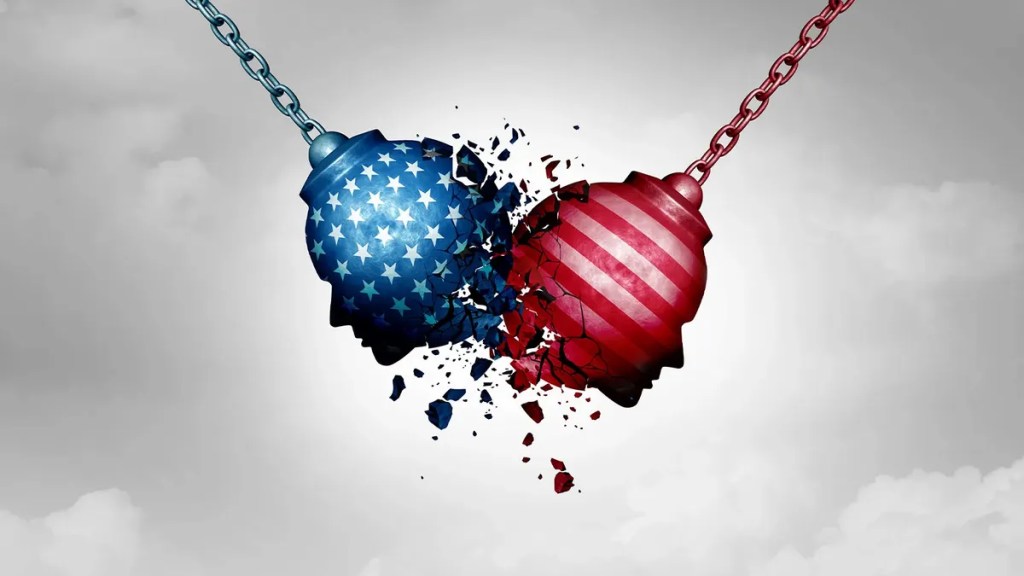
I have been listening, watching, and reading about the celebration of the 250th anniversary of the US’s independence from its colonial brothers. It all started with the Boston Tea Party, the cry of “no taxation without representation,” the ride of Mr Revere, and their ultimate victory at the Siege of Yorktown. Then the 13 US states declared independence on the 4th of July 1776, and the new US Constitution was adopted on the 4th of March 1789, creating the first democratic republic. The US Constitution tried to create a brave new world after the overthrow of British colonialism, but it was both inspirational and contradictory. In particular, around slavery, freedom, settler colonialism, and a system of government based on minority rule and with no clear guardrails around executive power.
Slavery was legal; there was no universal suffrage, and Native Americans were not classified as citizens of the new republic. George Washington, a founding father and slave owner, became the first US President. This experiment in democracy was described by George Washington as “The establishment of our new government seemed to be the last great experiment for human happiness”, for white people only. Sigmund Freud may have come closer when he said, “America is the most grandiose experiment the world has seen, but I am afraid it is not going to be a success.” Today, Freud is closer to the truth than we think.
The Louisiana Purchase of 1803 saw the US double in size with the purchase from France of 900,000 square miles of land for some $20 million, and this started the relentless journey West, which resulted in the displacement of millions of Native Americans, saw mass migration on a scale never seen before and was the beginning of the journey to make the US a superpower.
The brutal Civil War from 1861 to 1865 was fought to stop the South from breaking away from the Union and to end slavery. This cost the lives of 800,000 soldiers, twice as many as the casualties in World War II. The Civil War ended in 1865 with the absolute defeat of the Confederate forces, and in April of the same year, John Wilkes Booth assassinated Lincoln. The 13th Amendment was adopted to abolish slavery, which led to decades of resentment by white Southerners. Slaves up till then had more value on a balance sheet than the entire US gold reserves. The were so called 56 founding fathers, 41 of whom owned slaves and that included Jefferson, Washington, and Madison.
Discrimination continued against blacks, and the move westward saw the destruction of Indian culture and tradition, the stealing of land, which was an intrinsic part of their identity and the forcing of them onto reservations. It is estimated that European settlers and the US government of that period saw up to 8 million Native Americans killed, some in acts of genocide, forced assimilation, and disease. This genocide saw their population fall to some 300,000 by the 1900s.
From around 1870 to 1900, Mark Twain called this period the Gilded Age, a time of rapid industrialisation and economic growth alongside widespread poverty, political corruption, and deep social inequality. A small cohort of wealthy families and individuals, including household names such as Carnegie, Rockefeller, and Morgan, amassed huge fortunes while urban working classes and farming communities struggled with poverty. It was Theodore Roosevelt who began to break up these huge monopolies to protect American democracy and the American consumer. Supreme Court Justice Louis Brandeis, during his term, which ended in 1939, said that, “We must make our choice. We may have democracy, or we may have wealth concentrated in the few hands, but we cannot have both. He was right then, and it is true today.
However, America’s democracy was further eroded by the Supreme Court’s 2010 ruling in Citizens United versus Federal Election Commission, which allowed no limit to the amount of money in the political system. This turned on its head Lincoln’s line in the Gettysburg Address definition of government, which was” government of the people, by the people, for the people”. Today it seems that government in the US is government of the plutocrat, by the plutocrat, for the plutocrat.
Women got the right to vote in the 1920s, and it was the start of the journey toward universal suffrage. African Americans, characterised under the Three-Fifths Compromise under the US Constitution in 1787, got the uninhibited right to vote as an equal citizen under the1965 Voting Rights Act. FDR, through the New Deal in the 1930s, transformed the US and, in addition, in 1941 joined Churchill and the UK in defeating fascism in Europe. Also in the 1930s, Charles Lindbergh was a supporter of Hitler’s fascism and coined the America First phrase and was against America’s entry into World War 2.
From 1950 to the mid-50s was a period known as McCarthyism, named after Joseph McCarthy, a period of anti-communist hysteria and headed up by Edgar J. Hoover. Hollywood actors, teachers, academics, trade unionists, and members of the gay community lost their jobs, reputations, or freedom based on rumour and guilt by association.
Also, from the 1870s to the 1960s, the Jim Crow era, which was a state-sanctioned racial caste system in the United States, enforced strict racial segregation and the political disenfranchisement of African Americans. It was a strange mix of African American civil rights heroes such as Martin Luther King Jnr, Rosa Parks, James Baldwin, and Malcolm X, with a bit of political arm-twisting by LBJ that brought some meaning to “all men are created equal” and possesses unalienable rights to life, liberty, and the pursuit of happiness. This long battle for a modicum of equality was achieved by the passing of the Voting Rights Act in 1965 and the Civil Rights Act in 1964. Other brave Americans engaged in the struggle for equality, both black and white, in Selma, the children and parents in Brown v. Board of Education in 1954, and the likes of Frederick Douglass, Harriet Tubman, Henry Highland Garne and Abby Kelley Foster.
That is the past, and on the face of it, there is not a lot to celebrate today despite Reagan’s description of America as the “shining city on the hill” and the term American Exceptionalism. Apologies, I forgot to mention the debacle of the Vietnam War, in which 8 million tons of bombs were dropped 3 times more than the US dropped in the whole of World War II which also saw 50,000 US troops and 3,000,000 Vietnamese killed and then America withdrawing with its tail between its legs.
Today in the US is another Gilded Age where the likes of the Tech Bros such as Bezos, Zuckerberg, Musk, Altman, Huang, and Thiel, who believes freedom and democracy are incompatible, are nestled in bed with the plutocrats in President Trump’s White House. These Tech Bros, with their AI, are changing society without restraint, not just undermining the future of work but democracy and social cohesion. The Republican Party, including JD Vile and the self-serving sycophants in Trump’s cabinet, now worship a President who is created in the image of Caligula and Nero and who, within 24 months, has turned a flawed democracy into a corrupt plutocracy. Another way to describe this system of government is a griftocracy. In addition, some of Trump’s voters believe he was sent by God as some sort of Messiah; if that is the case, God himself must then be a narcissist. The US has withdrawn from various international bodies, and Trump and his team are climate deniers in the face of the evidence before their very eyes.
Trump and his family have made billions on insider trading and crypto and have extracted hundreds of millions from unitary Islamic absolute monarchies, otherwise known as self-serving dictatorships, many of which have cosied up to Netanyahu’s genocidal government. It was during the genocide in Gaza that Trump, Kushner, and Witkoff were getting excited about a new Riviera built on the bodies of 75,000 Gazans, including 20,000 children.
The so-called independent parts of the US government are breaking down: that is, the rising unchecked power of the presidency, which continues to push the boundaries of executive power. The ass-kissing and subservient Congress and the politically appointed Supreme Court, neither of which is doing its job. https://thegob.org/2025/09/20/a-three-state-solution/. Add to this the manifesto of Project 25, and the growing Christian and White nationalism, which feels like a journey to Margaret Atwood’s Gilead.
The current regime in the US is undermining alliances with long-standing allies in Europe and Canada, which include a tariff war, constant interference in their politics and undermining NATO, yet literally rolls out the red carpet for XI and Putin. (https://thegob.org/2025/04/12/economic-vandalism-or-insider-trading-on-a-global-scale/ )
America remains the world’s largest economy and the biggest military superpower; however, it is no longer the only kid on the block. China is now on the global stage, allowing it to push back on Trump’s aggressive tariffs while we in Europe capitulated. Russia is a petro state designed around a Stalinist framework and has only any clout because of its 6000 nuclear warheads, and India is coming up on the inside, whose population is now the largest in the world. The US has abandoned Ukraine, and the current regime’s commitment to Taiwan looks questionable. He has allowed and armed Netanyahu to commit genocide in Gaza; that is not just me saying this but B’Tselem, a Jewish human rights organisation based in Jerusalem, in a ground-breaking report called “Our Genocide.” Trump has decimated America’s soft power by dismantling USAID but has given Immigration and Customs Enforcement (ICE) an additional $70 billion. As much as I detest the totalitarian Islamic Republic of Iran and its leadership that has killed tens of thousands of its own people, this war was not necessary. Why? Because religious zealots are not just willing to sacrifice themselves but anyone else to retain control and prove that God is genuinely great, and that has cost the US taxpayer $100 billion and the rest of the world economic pain with no end in sight. The Iranian regime now knows: screw the nukes; we have the Straits in our murderous hands.
Economically, the US runs a debt-to-GDP ratio of 119% and a $40 trillion national debt but sleeps comfortably for the near future as the dollar remains the world’s reserve currency and its stock markets represent, according to a variety of sources, 60% of global stock market value.
To top it all, Secretary of Defence Pete Hegseth, a man with no redeemable qualities as a human being, just announced that Nidal Hasana, a soldier who fatally shot 13 unarmed US soldiers at Fort Hood in 2009, will be executed by firing squad, and, to top it all, it will be live-streamed. The other irredeemable human being, Trump, has approved this. These sorts of public executions are carried out in Iran and Afghanistan, and IS has allowed the live streaming of its own public executions. Hegseth and his boss now see a public execution as a form of entertainment. Is this what the American people want, and is this what celebrating the 250th looks like?
Finally, Trump, the cry-baby narcissist and grifter supreme, has gone into a rant about not receiving the Nobel Peace Prize, which he feels should be his by right, for all the imaginary wars he has stopped. He wants the Nobel committee and us to overlook Iran, Venezuela, his threats to invade Greenland, the support of the genocide in Gaza and his respect and envy for Putin and Kim. He went on to rant that “The Nobel Peace Prize has been forever discredited by a handful of radical ideologues who are anti-democracy and really enemies of civilisation,”. The grumpy halfwit also said that “This is an indelible stain on the country of Norway”, adding, “we ( meaning he) will not forget”. Just by the by, Navi Pillay from South Africa, a former UN human rights chief and International Court of Justice judge, received the prize. She was given the award for her decades of unrelenting dedication to upholding international law and prosecuting war crimes and genocide.
So, the question is simple: what is there to celebrate on this 250th anniversary of American independence? In my humble opinion, not a lot. But it would not be a bad time to reflect on the past 250 and whether there are another 50 years left in this setup or if you, the American electorate, are on your way to seeing a two-state solution long before the one we really need, and that is in Palestine.
Suneil Sharma
12th October 2026


Leave a Reply