
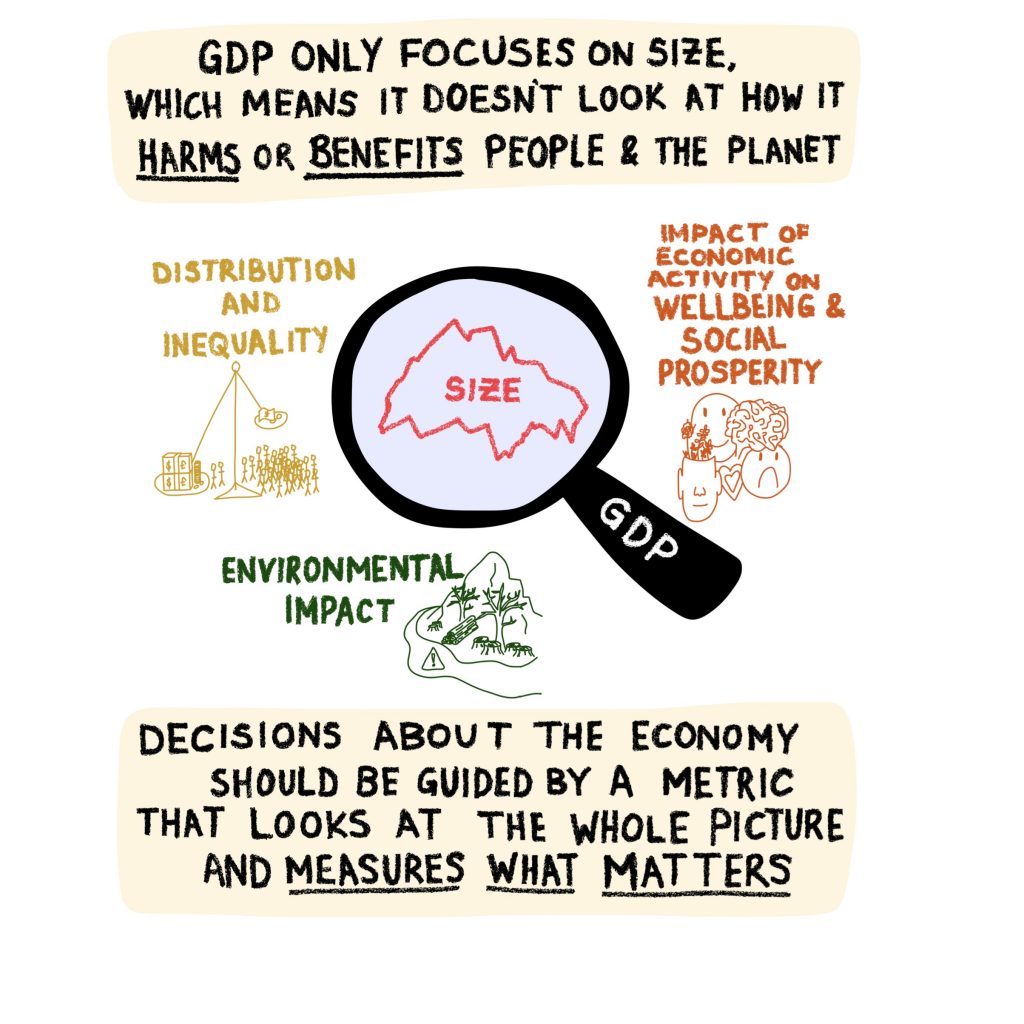
n 1934, Simon Kuznets created the term Gross Domestic Product as a snapshot of a country’s prosperity, economic health, and output. His theory hypothesised that as the economy grows, inequality increases until a point where future growth reduces inequality. The Bank of England defines it as the total monetary value of all goods and services produced within a country over a period of one year. Even back then, Kuznets was clear that GDP should not be used exclusively and was not an indicator of a country’s welfare and standard of living, though GDP per Capita has been articulated by economists and politicians as such a measure. His theory does not stand up today due to complex supply chains, globalisation, financial globalisation, profit-shifting by transnational corporations, tax havens, and other factors. Since the adoption of GDP and the embrace of Hayekian Neo-Liberalism and Laissez-Faire economics in the 1970s, GDP has become the economists’ version of “the first commandment” attached to growth, making it the singular definition of human flourishing. In addition, the GDP measure is based on consumption, which has been accelerated by the financialisaton of economies, allowing all of us to have all our tomorrows today without being aware of the impact not just on us, but on our planet and on other members of our species. This can be seen in the form of growing national and global wealth inequality and the failure to recognise the huge costs of externalities. These externalities are not priced into goods we purchase as consumers in the so-called developed world. In effect, we have become consumers of the world, accumulating stuff rather than citizens of the world. These externalities include costs such as the climate crisis, water pollution, air pollution, conflict arising from the exploitation of minerals in poorer regions of the world, the significant decline in biodiversity, deforestation, melting ice caps and plastic pollution, to name a few. The Earth Overshoot network reports that for the world’s population to have the standard of living comparable to the UK would require another 2.6 Earths.
Regarding wealth inequality today, according to the World Inequality Report, 1% of the world’s population control 40% of the world’s wealth and the next 50% control 2%. Here in the UK, Top 10% of households hold 60% of UK wealth, the bottom 50% hold 5%, and 23% of adults have less than £250 in savings. According to the World Bank, 700 million people earn less than $2.15 a day, and 4.0 billion people live on $6.50 a day. It is the people in countries in Africa and Asia who earn between $2.15 and $6.15 a day who make our fast fashion in the form of Primark’s £9.00 jeans and the £3.50 tee shirt. Thomas Piketty clearly states about rising inequality that “ Inequality is neither economic nor technological; it is ideological.” We know who has that ideology in the palm of their hands.
So, growth in the form of GDP is embedded as a mantra within our political class. In Kate Raworth’s book Doughnut Economics, she says that growth has been portrayed as an economic panacea for all ills, from national debt to tackling poverty and trade imbalances, but ignores the thorny but necessary need for redistribution, tax justice, and tax reform on a global scale. In the 1990s, Donella Meadows, a visionary thinker and one of the lead authors of the 1972 Limits to Growth report, spoke out against the then and unfortunately current economic orthodoxy that “ growth was one of the stupidest purposes ever invented by a culture”. She went on to add growth of what, and why and for whom, who pays for it and at what cost to our planet’s ecosystem. A simple fact is that 16% of the world’s population produces 33% of the world’s GHG.
The embrace of GDP as the only measure of human flourishing has been kidnapped by neoliberalism, and neoliberalism has been hijacked by the very wealthy. This has also bestowed the very wealthy with political influence through campaign financing, which protects their wealth by the state allowing monopoly power, and lobbying for unfair tax policies, thereby underpinning the principle of shareholder tyranny. John Stuart Mills put it like this, “ rentier landlords that grow richer as it were in their sleep without working, risking or economising.” The rentier landlords of today are platforms like Facebook, x, Instagram, TikTok, Uber, Airbnb, and Amazon, created by the likes of Bezos, Musk, and Zuckerberg. These digital overlords are described by Bennett School of Public Policy as extractive rentier capitalists, like landlords, in that they do not make anything. Thatcher’s Hayekian ideological Tory government in the 1980’s privatised public services, such as water, electricity, telecoms, turning public wealth and assets into monopolistic income streams owned by private equity and sovereign wealth funds based in the Middle East. According to the University of Greenwich, shareholders in the UK water industry have extracted nearly £90 billion since privatisation, in addition to racking up debt of around £70 billion.
In the case of the direct correlation between wealth and political influence. In the US, in 2010, this was exacerbated under the ruling by the Supreme Court in the case of Citizens United versus the Federal Election Commission, which opened the door for the very wealthy to corrupt the political system and process. This translation of wealth into political power can be seen in the practice of oligarchs in Putin’s Russia and among the 12 billionaires in Trump’s Cabinet. Trump, Kushner, and Witkoff see the destruction and genocide in Gaza as a real estate opportunity.
Regarding the redistribution point above, a more equitable tax system in UK, according to the University of Warick’s Centre for the Analysis of Tax Reform which would include a wealth tax of 2% on assets exceeding £10.0 million, along with comprehensive reform of capital gains tax and national insurance on rental and investment income, would generate approximately £ 44 billion annually, and this excludes the case for a land value tax. Just a side, Amol Rajan on his recent podcast Radical, where he interviewed Emma Grede ( one of his worst guests), said something really patronising and stupid, “it’s embarrassing to be poor”
The consequences of this concentration of wealth, political power and political influence undermine democracy by eroding its participative principle. Just to put this into some perspective, according to Oxfam’s 2026 report, there are over 3000 billionaires, and a mere 12 of them have more wealth than the poorest on this planet, that is, 4 billion people. A 100 years ago, Supreme Court Justice Louis Brandeis said, “We must make our choice. Either we can have extreme wealth in the hands of the few, or we can have democracy. We can’t have both.” I have read Irene Robyn’s book Call Limitarianism, which articulates a limit on wealth. Its premise as an entrepreneur and risk taker was counterintuitive, though, given what I have said earlier, there is some merit in this proposition, though the limitation to the level of wealth would need to be agreed upon as part of a democratic dialogue. Is it 10, 20, 30, or 40 million dollars? Amartya Sen, amongst others, says that GDP conflates economic growth with human well-being and human welfare in areas such as health and education with wealth accumulation.
In Doughnut Economics, Kate Raworth describes the doughnut as a starting point for a new model of economics. At the outer edge of the doughnut, you have the ecological ceiling; crossing it will have catastrophic impacts on the planet, including climate change, ecocide, land conversion, and rising sea levels. On the inner part of the doughnut, you have the social foundation, which, in effect, is Maslow’s hierarchy of needs, plus energy security, water security, social equity and a political voice. The mass of the doughnut she describes as a safe and just space for humanity. This is radical in that it is species-focused and not just on us; in addition, it puts our planetary ecosystem at the centre of the political economy.
To finish, the goal of growth articulated in the myopic formula of Gross Domestic Product in the middle of the Anthropocene can be fairly described as stupid, and it is time to end this approach to economic thinking in the form of consumption-led Neo Liberalism. It is clear we need a new mantra to redefine human flourishing, and this can be understood better in reference to the aforementioned doughnut. What we can say is that we will not find the answer in laissez-faire Hayekian free-market economics or the trickle-down effect. The time has come for the next generation of economists and the political class to begin consuming the Doughnut in the interest of future generations.
Suneil Sharma
1st May 2026 ( my birthday)
Share this:


Leave a Reply