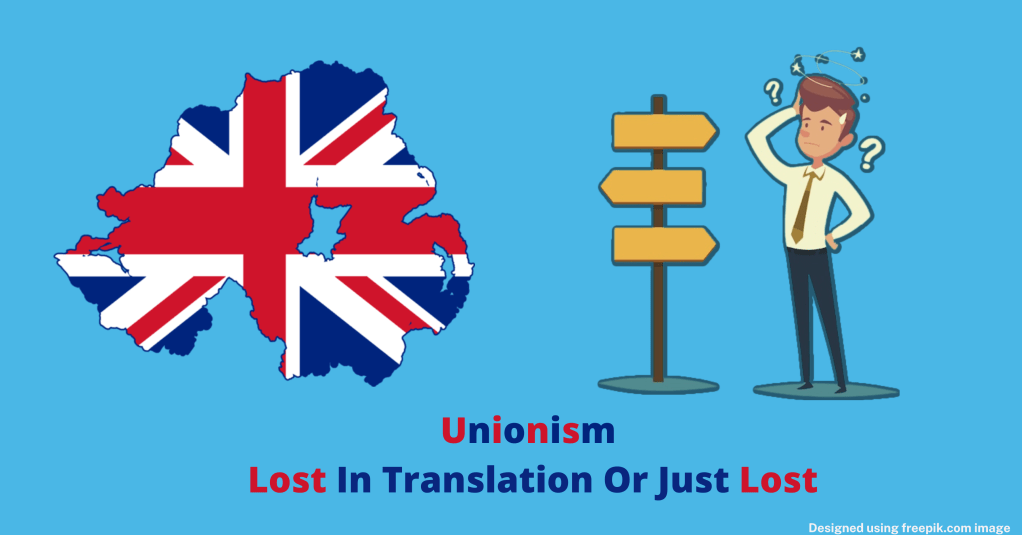
Firstly, I write this short piece, not as a Unionist, not as an Irish Nationalist not as a political historian but as a political orphan, for much of my adult life. More importantly, I write this more akin to a Greek Tragedy. I grew up in Belfast in the ’70s/’80s and as a child and teenager, I saw the “Troubles” through the prism of Bloody Sunday, Internment, the Oxford Street bomb, La Mon Hotel, Greysteele, Dublin and Monaghan bombs, McGurk’s Bar and Kingsmill. Though I was a member of a community that was not directly scared by the conflict, it impacted my political engagement and understanding of politics here. Then in the 90s, the journey to peace and the 1998 Belfast Agreement.
The Belfast Agreement, otherwise known as the Good Friday Agreement, achieved three things, ended decades of violence, gave much hope for a better future, and saw the end of the Unionist hegemony. We are all grateful for the first two but the third therein lies the Greek tragedy, the end of the Unionist hegemony. The main impact of the 1998 agreement has seen Unionist parties unable to navigate the new political landscape. One could also say that they have been going through political cold turkey, ever since. In addition, Unionists have had to do something that does not come naturally: being part of and now, a smaller part of a coalition government. To be more accurate, part of a mandatory coalition which is an oxymoron. All of this has reinforced a siege mentality that has existed for decades. It is this siege mentality that is core to the unionist political identity.
Upper-middle-class unionist brothers have embedded this siege mentality in working-class protestants. The aim was never really about the needs or aspirations of those working classes, but about how to cling to power. This political tragedy undermined the development of working-class politics and embedded the great con, that working-class William and working-class Seamus have nothing in common. The consequence was that the Civil Rights Movement was seen as a Catholic insurgency and the Sunningdale Agreement as a sell-out and a betrayal by the British Government. The late Seamus Mallon showed great political insight when he described the Belfast Agreement as Sunningdale for slow learners, you wonder to whom he was referring.
The first question is, is unionism a political ideology? Well, quite frankly that would be a difficult question to answer, even for a Politics, Philosophy and Economics Oxford graduate, Liz Truss. If a political ideology is a spectrum from far-left communism to far-right fascism and everything in between, it would be difficult to fit unionism anywhere in that spectrum. I would tend to describe unionism as a mindset, that is based on an underlying fear of change, the loss of the very hegemony mentioned earlier, fear of the other, a lack of vision for its constituents, failure to show real leadership in a new political ecosystem and failure to adequately advocate for issues that affect the daily lives of their working-class constituents. Let us not forget, the hostility to Irish unification. Working-class Protestants were also led to believe that in the post-1998 world Catholics were getting everything, at their cost. The truth is, it is the failure of their political representatives to do what they are elected and paid for, which is to advocate for the interest of their constituents.
I am aware of new-fangled labels such as “civic unionism” which has no kudos as a political ideology. This term was invented by a bunch of cuddly unionist academics as a counter to civic nationalism. Please note, that civic nationalism as a political ideology is not owned and was not created by Irish Nationalists. It came out of the enlightenment in the 18th century and is based upon shared citizenship and shared values, all underpinned by a liberal democratic state. See, nothing to fear.
Unionist identity has become more of a caricature, with many people (including middle-class unionists) seeing that identity through the prism of the orange, the 12th, the word no, mediocre murals, no craic, loyalty to Crown and never trusting a Catholic. Then there is the culture war around language and whether Ulster-Scots is a language or a dialect. I would respectfully pass on that one, though it would be fair to say that republicans have played their part in the politicisation of the Irish language. The loyalty to the crown and Britain is not exactly reciprocated, well, only if you believe that an odd visit by a member of the royal family is reciprocation. Unionists are often ridiculed in the British political establishment and hard-line Tory Brexiters would have gladly sacrificed the 6 counties for a hard and clean Brexit. Now unionists have found something new to complain about: the goddam Protocol. A Protocol they embraced, by believing the serial liar, Boris.
That says a lot about their political antennae and naivety. It would also be fair to say that Coveney and the Irish Government’s position on dealing with issues around the Protocol could be described at best, as unhelpful and at worst, obstructive.
Recently, all persuasions of unionism have all come out in unison and moaned about the Shadow Northern Secretary, stating the bloody obvious. Even more bazaar, some unionists have criticised Steve Baker, yes, Steve Baker the arch-Brexiteer who is trying to build bridges with the EU to bring the Protocol saga to a satisfactory conclusion.
As for the parties that say they wish to protect the union, neither of the two largest Unionist parties has done a particularly good job. In recent times they have lost votes to the ideologically devoid Alliance Party and for the foreseeable future can only expect to fill the post of Deputy First Minister.
The UUP the party which helped deliver the Belfast Agreement have been unable to capitalise on that momentous event and has ever since been trying to work out its message or for that matter its purpose. The current leadership seems to be bereft of ideas to deal with the challenges of today, forget the future and at best look like a DUP B team. Recent manifestos would put you to sleep and are full of platitudes, like strengthening the union. Their electorate is dwindling, as it is largely made up of white, grey, over 60 social conservatives. The current leadership promised to reform party structures, increase membership and create a new political narrative, in this, they have failed. For those who voted UUP and thought that making a former naval officer leader would bring intellectual rigour and gravitas to the role, look where that got you. The new leader Mr Beattie seems a nice enough guy, that is on the basis you overlook past misogynist and racist social media posts. So, if UUP voters believe he is their political messiah, dream on. Beattie has more identity labels that you can shake a stick and if you define liberal as not taking a clear stance on anything, the UUP are the new liberals.
I would now characterise the DUP as “THE Death of the Union Party”. Their stance on Brexit and the RHI scandal did not endear them to Tories and English voters in general. Today, the DUP continue to bang on about the Protocol while voters in GB have other pressing concerns, such as the cost-of-living crisis, inflation, war in Ukraine and not to forget the misfortune of being lumbered with an excuse for a Prime Minister, Liz Truss.
The DUP have no respect within the Westminster political establishment because they overplayed their hand during the Brexit negotiations and are doing the same with the issue of the Protocol, therefore putting Northern Ireland’s constitutional position at risk, something the Provo’s could only have dreamed of. In addition, Jeffery’s new political wingman Jamie has done nothing to enhance the DUP leader’s already dwindling political stature.
The DUP, or for that matter no unionists attended the Labour Party conference, the simple question is why the hell not? It again seems like the sort of political self-harm that unionists have come to enjoy.
In respect of the United Ireland debate, unionists take the “playground position”, we are not playing. I believe this shows political weakness, not political strength, and is a dereliction of duty to their constituents. They need to take an “anytime any place and anywhere “approach to making their case for the union and hold Republicans’ feet to the fire about what a “New Ireland “is going to look like. I will give unionists a bye-ball, for not attending the “Saturday 1st of October Jamboree”, as it did look like an event that was preaching to the converted. However, unionists need to make their case to maintain the union and challenge the idea that a united Ireland will create a political and economic utopia. It is absurd that unionists shy away from this debate. They must summon up the political courage and the wit to engage in a debate about a new and united Ireland. One thing is clear, when unionists engage in this debate, they will have significant leverage in shaping this new Ireland, the sort of leverage that the 8(that’s out of 650,1.2%) at Westminster can only dream of. The core debate around a new Ireland is about a governmental structure that ensures that all citizens have a voice and a stake in this new Ireland. This could be a “Dev Max” structure on a provincial basis, with participation guarantees for a section of new citizens, of this new Ireland. The only proviso is that whatever the agreed outcome, it does not look anything like the dysfunctional mandatory coalition we currently have. I believe, (call me a political optimist) if properly communicated to the unionist community, a robust engagement will not be seen as a Chamberlain-type capitulation but as real leadership, something that ordinary unionists have been devoid of for decades.
As someone with the surname Paisley (not the preschool one) has said, talk of a united Ireland is not as easily dismissed as it once was. He is right, but the journey to Irish unification is not straightforward, with issues around the integration of public services, education, economic integration, healthcare and maintaining and enhancing the bonds between Ireland and the rest of the UK.
Let us be honest, unionism is on the political ventilator and the fear of unionist politicians being branded as “Lundy” should not paralyse them from engaging in conversation around a new Ireland. Working-class protestants need leadership on this issue; this may be the first time their political representatives have a chance to show some in a long time.
Just to put unionists’ minds at rest about the census, the group that will determine the pace of Irish unification are not Catholics, but a group the census does not highlight, the middle classes. They will see a united Ireland through the prism of economic security, taxes, health care, education and not through the prism of religion or the creation of some sort of political utopia.
Let me know what you think in the comments below 👇
Suneil Sharma


 The Gob
Leave a reply to Gordon Markey Cancel reply