
The Ram Foundation in partnership with the YMCA has launched a ground-breaking programme to get young people, informed and engaged about the multiple issues that will affect their futures. These will include, the climate crisis, political activism, identity, politics of the island of Ireland, national and geopolitics, how to navigate the complex information ecosystem, social justice, and the future of work. When asked by a young person what was the greatest threat to their future, I responded by saying you and pointed to the group of young people present. Then I went on to say, “the greatest threat to your future is you and your failure to engage in shaping your future.”
At the heart of this future is how the young embrace democracy, as the route to delivering that new future. The recent Onward Report “The kids aren’t all right” suggest there are problems. Any assumption that democratic values are hardwired into the young of this generation, is misplaced.
In France’s recent presidential elections Marie Le Pen got 39% of the 18–25-year-old vote and Trump got 35% of the 18–29-year-old vote. In the UK according to the Onward report, young people are more likely to vote for an authoritarian/strongman than the messy compromises of a democratic system, if they had a choice.
The report highlights four reasons, I will focus on two:
- Narrow Social Networks: identities more polarised, less socially diverse, less likely to see themselves as part of a community
- Overprotective parenting
- The treadmill of modern work: where past certainties seem beyond reach and burnout
- “Always online” culture: more online friends than real ones, creation of bubbles, retreat into echo chambers, diminution of interpersonal skills,
All, of these, have created a disconnect amongst young people and a disconnect between generations.
The report describes the interlinked symptoms of the young as “atomisation” which leads to social isolation, retreat into an online ecosystem, social networks becoming less diverse, the feeling of declining economic opportunity, uncertainty about the future of work and a dream that seems as far away as ever, the ability to buy a house. All of this is leading to an acceleration of young people becoming detached from democratic values and principles. The report highlights this by a simple stat, that 61% of 18-34-year-olds agree that having a strong leader who does not have to navigate the messy processes embedded in a democracy, is an effective way to govern. The report also highlights differences between young people, in that more people who feel economically and politically disenfranchised would support an authoritarian system.
This can lead to ideas, which are usually on the fringe of democratic dialogue getting an amplified voice through social media networks. This can be seen in how” stop the steal” and Pizza Gate energised a segment of the American electorate. Here, during Brexit, it was the” invasion” of migrants, British sovereignty and the UK is run from Europe. These narratives moved the option polls from 60% to remain to a final 51%/49% for Brexit. It would also be fair to say that the rise in right-wing populism in the US and Europe and the resulting polarisation is also a consequence of a failure of those in power, to anticipate the downsides of globalisation and offshoring. The idea that the mantra of shareholder value and cheaper goods would mitigate issues around income inequality and job security was sadly misplaced. In addition, the belief by “elites” that trickle-down economics would be embraced and become the new economic orthodoxy, was a way of the mark
This report points out that the embrace of social media is fuelling political polarisation. Haidt explains that t elements bind successful democracies.:
- Social capital
- Institutions that are strong, I would also suggest accountable and open to public scrutiny
- Shared stories, I would also suggest the good the bad and the ugly should all be shared.
The infamous right-of-centre political strategist /agitator Lynton Crosby is quoted saying that social media platforms are “echo chambers of anger,” exploited effectively by the very same person.
The question is, how we ensure that we break the trend toward micro-communities, where young people reside in echo chambers and bubbles. The report makes several suggestions, I will focus on two:
- Establish a national civic service scheme to strengthen democratic norms and encourage social mixing: They use the AmeriCorps Scheme as an exemplar which is an agency of the US government. The report quotes a lot of stats about social mixing, voting and employability. I am sceptical about any scheme run by the government. Any government-funded scheme/structure would have to be independent, with a ringed-fenced budget and work in partnership with schools to embed civics into the educational timetable.
Encouraging social mixing across class, ethnicities, income levels and educational attainment is a tall order, especially when two-thirds of the cabinet went to fee-paying schools and half went to Oxford or Cambridge. An underlying problem may be the distance between the governed and those who are doing the governing.
- Introduce mandatory age and identity checks on social media and encourage platforms to introduce opt-out usage limits: They suggest access to government databases to identify users and hold them accountable for online posts. Government and social media platforms in cahoots seem a bit big brotherish for me. They suggest the use of Orwellian ways of mandatory age checks on social media by matching ID documents to selfies or facial age recognition.
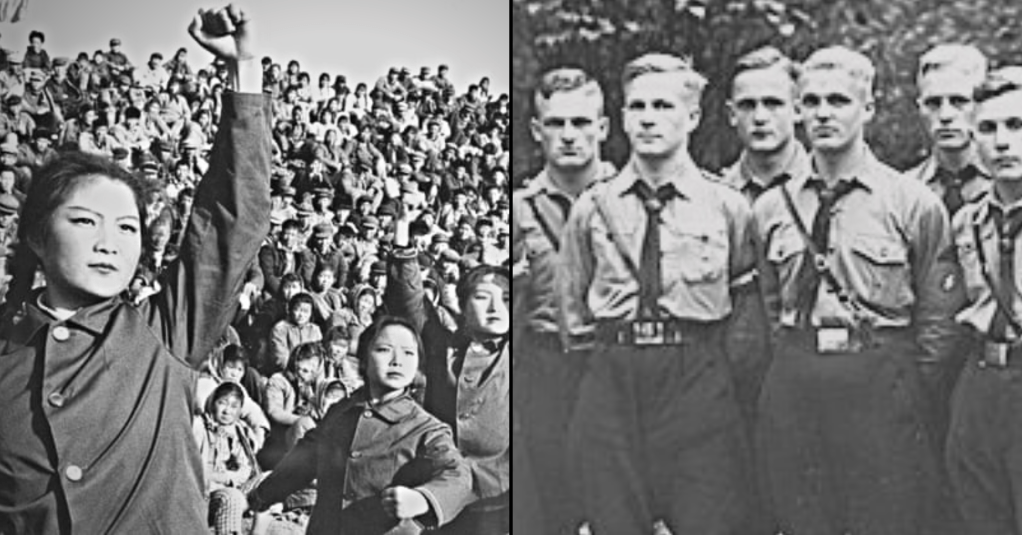
One thing we can agree on is that there is an issue with the engagement of young people in democratic dialogue and the importance of young people being culturally, socially and politically engaged. Understanding the importance and value of pluralism while dealing with some of the issues is vital to ensure that they have a voice and stake in their futures. How we do this is by working in partnership with vast resources of the educational establishment and the vast experiences of NGOs and embedding important democratic norms into our education system. Just to be clear, this is not about creating a “Hitler Youth” but giving young people the tools to help shape their futures, navigating a complex information ecosystem and how to think and not what to think.
One area that do not come up was the issue of compulsory voting and voter turnout as a measure of its success. In Belgium’s 2018 election the voter turnout was 90%. What I am not implying, is that compulsory voting is the silver bullet that underpins the survival of democracies. I remained to be convinced by the mere fact, that the word compulsory is used. Let us look at several reasons, for compulsory voting and several against it.
For:
- Voting is an essential duty of being a citizen, just like paying taxes.
- Increases the legitimacy of elections and stops the tyranny of the minority.
- Enhances interest in politics and improves political activism.
- Choice is improved making “none of the above” a genuine choice.
- Candidates need to address the needs of all voters, not just the elite, the better educated, the better off and the powerful business lobbies.
- Compulsory voting can be more responsive to voter concerns, as was the case in Australia where climate change topped voters’ concerns.
Against:
- Can be seen as a trajectory toward authoritarianism.
- A coalition of disinterested, disengaged and ill-informed people who vote. Here we need to learn the lessons not to denigrate any part of the electorate remember the “Deplorables”
- A voluntary system is not biased towards the wealthy, grey comfortable and white and the middle class.
- Does not improve political engagement.
My instinct would be against compulsory voting, but a case can be made for compulsory voting but only after a thoughtful civics and politics curriculum is devised and has been embedded into the educational system, along with the tools for young people to navigate the complex information, misinformation and disinformation ecosystem. It is the right time for this debate considering the ONWARD report. Hopefully, whatever we do to engage our young to become politically active, I hope they will conclude that “democracy is the worst form of government – except for all the others that have been tried.” Winston Churchill.
To finish I will paraphrase Chomsky, the greatest threat to our future is an ill-informed and disengaged electorate. The cynic in me says, that is what our political establishment wants.
Let me know what you think in the comments below 👇
Suneil Sharma
5th October 2022

 The Gob
Leave a reply to Paul Collins Cancel reply