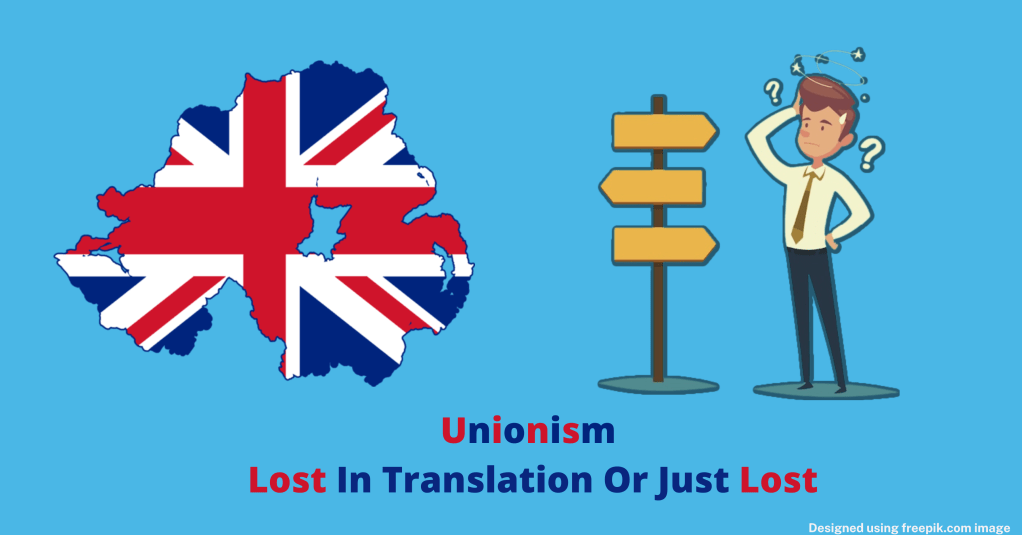
The interview with Wallace Thompson in the Irish News revealed a eureka moment; he recognised the inevitability of a new United Ireland. Like other believers, he has failed, like them, to define what will be new in this new and United Ireland. He sounded like a forlorn political orphan or someone engaging in political flagellation. His contradictory understanding of identity is at best peculiar. When I am asked about my identity, I say, “The label belongs to you,” as said by the late great James Baldwin. Wallace says he feels more Irish but wants to retain his British identity. Does that mean he supports an identity that includes slavery, historic British colonialism, imperialism, and the sectarian disasters here and in places like India? His understanding of history is flawed; it was not Protestantism that held the empire together, it was the East India Company, the world’s best navy, the bounty of colonialism, the slave trade and the civilising zeal of eugenics.
Here he ignores the failure of leafy suburban unionism over decades to represent the real interests of Protestant working classes, instead sowing the fear of a Catholic insurgency, as seen in the Civil Rights movement or Sunningdale. Seamus Mallon called the Belfast Agreement “Sunningdale for slow learners,” with Wallace being one of them. He seems to have overlooked that he and many others like him bred and enforced the political myth that working-class William and working-class Seamus had nothing in common. In reality, working-class William had and still shares more with working-class Seamus than with his upper-middle-class unionist brothers and sisters in leafy Belfast suburbs like Helens Bay or Hillsborough. This fostered a siege mentality among working-class Protestants, which was also evident in the Brexit vote. We have seen meaningless new terms like “Civic Unionism,” but the simple truth remains: the Protestant ruling class has failed to advocate for the genuine interests of their community because it was easier to shout “never, never, never, never.”
Unfortunately, so-called political unionism is on a political ventilator and now needs to be actively engaged in the political future of this island. Former unionists would have more representation in a new Dáil, is stating the obvious, but the real question is whether they will have more clout and a louder voice. He seems agnostic about a new governmental structure, whether unitary or regional. Has he forgotten the failed, visionless, dysfunctional, and oxymoronic structure known as the Northern Ireland Assembly? It is all part of an important debate. He also fails to highlight the complexity of establishing a new Ireland, on which, to date, next to nothing has been done. These will include issues such as the integration of public services from healthcare to education, the criminal justice system, who pays for it and the cost. The additional annual cost of unification could absorb the Irish government’s yearly budget surplus of €8.0 billion. Ireland has become more multicultural, but still, the Catholic Church in Ireland has a stranglehold on education and remains one of the three institutional pillars of Irish society.
First and foremost, I’m an atheist; my new Ireland must be secular, built on values, ensuring the division of working-class people is not repeated, all underpinned by a public policy platform built on the principle of social cohesion. This interview with Wallace Thompson seems more like” buyer’s remorse” and adds absolutely nothing to the debate about our collective futures on this island.
Suneil Sharma
24th June 2024
 The Gob
Leave a Reply