
I
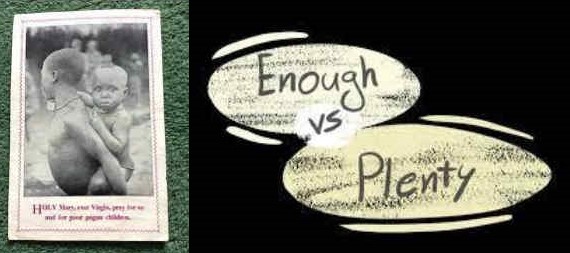
I attended several events at the 2024 Imagine Belfast week and to be fair, enjoyed each one. The first was “Fairer but Smaller”, an event based on a book called “Enough is Plenty. The whole premise was that the solution to the climate crisis was the need in simple terms, to reduce consumption in the global north and share that reduction to improve the lot of those who live in the global south, a sort of global redistribution. This assumed that a steady state of sufficiency and enough was part of the human condition. The question that failed to be considered was “Is humanity as a collective agent an Illusion? The speakers called for a new global social contract to decarbonise at a time when national social contracts are breaking down, as illustrated in Darren McGarvey’s book, The Social Distance Between Us. Some contributors called for a universal basic income and described the national debt as a financial illusion, implying that we quantitatively ease ourselves to utopia. QE did not improve economic growth or investment but created asset bubbles that we still suffer from today. It was this very policy of a “magic money tree that created a trickle-up effect. What we need is a fairer and redistributive tax system, a wealth tax, a permanent windfall tax on energy companies and Big Oil, up to 20% on annual profits, rapid though focused investment in the green transition and a virtuous circle of investment, both in aid and governance in the global south. However, at the moment, as the world polarises the planet continues to burn.
I also attended an event called” Climate Justice” hosted by Trocaire, which is an overseas development arm of the Irish Catholic Church. Climate Justice is a phrase that many overseas charities have latched on to. The panel failed to define climate justice in any depth, failed to lay out a road map to deliver climate justice, how to measure its success, and the scale of investment and support required for countries in the global south, as the world tries to decarbonise. The goal of climate justice is trying to be delivered, in a world in which 1% of the world’s population holds 40% of the world’s wealth and 50% holds 2%. In pursuing climate justice, we cannot ignore this criminal level of global inequality.
One panel member pointed out that COP 27 was a success in that a resolution was passed to set up a loss and damage fund of $700 billion to support those countries that will suffer the worst from climate change; just to be clear, caused by the industrialised west. Quite frankly, this is peanuts when measured against some estimates that suggest that we, the human species need to invest $3-5 trillion both towards the green transition and ensure meaningful climate justice. This sounds huge, please note the world spent $10 trillion to fight a pandemic called COVID-19. Again, to put the £700 million into some perspective, it represents a tenth of what is being spent on the Dubai Expo City, Mad Elon lost 32 times more in the first year of running Twitter and the Qataris spent over $200 billion on staging the World Cup.
Another panellist, a member of the Christian Jubilee Farm project in Larne, waxed lyrically in broad-brush terms about the climate crisis. He failed to mention how agribusiness was harming the planet, for example, the 70 billion animals that we kill each year to fulfil our species insatiable appetite for meat. This alone contributes between 15 and 20% of the world’s carbon emissions. No mention that we have been hooked on cheap food and are clearing rainforests to expand intense livestock farming. No mention of how farming and food production were negatively affecting biodiversity. No mention of how climate change will affect the availability of the molecule that sustains us, H2O, the lack of which will cause a migration from the global south to the global north on a scale, that not even the Bible could have imagined. Overall, this event was a tree-hugging sort of an affair, neither engaging nor informative.
Finally, Trocarie showed a video of their aid work and at the end showed an African man outside what I presumed was his village home, holding up a poster saying, “Climate Justice Now”.
A Black man with “no agency” asking the predominantly white global north for charity and help. This was an inappropriate caricature of Africans which reminded me of how images of “poor “Black Babies” were used by Catholic and other Christian charities in the 50’s and 60’s to illicit donations on Sundays. The poor Black Baby is now a poor Black Adult. Let me be clear the poor Black man portrayed in the video is still coping with the post-colonial legacy, the plundering of resources under the myth of globalisation “that a rising tide lifts all ships”. These injustices are now being exacerbated by the climate crisis.
Finally, Finally, the goal and delivery of climate justice should and must be a global endeavour and is not simply an act of charity directed towards “Poor Black Adults”. So, my advice to Trocaire is this, your poster should show people from all walks of life, from all parts of the world, all colours and appearances, able and disabled, with the very same important message, “Climate Justice Now”.
If I have left anyone out, please forgive me but what is clear is that the pursuit of climate justice is an endeavour for the entire human race, but a reminder of the question that underpins it all “Is humanity as a collective agent an illusion”.
Suneil Sharma
31st March 2024
 The Gob
Leave a Reply