
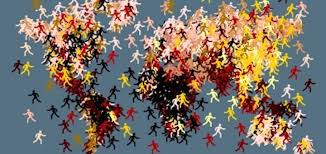
I have often mentioned that the greatest existential threat to our species is the climate crisis and its implications for global stability. So, let’s look specifically at it through the prism of climate-related mass migration in 4 areas:
- Climate mass migration because of failed harvests resulting in food insecurity in Africa and the global south.
- Climate mass migration because of increasing ungovernable spaces, failed states, and related conflicts.
- Growing international income and wealth inequality where only citizens in G20 countries (some more than others) can afford healthcare, education, and energy.
- The implications of mass migration on host communities and their political ecosystems, particularly in the form of the growing influence of the far right.
Food insecurity is rising as a direct consequence of climate change. It is estimated that 80% of the global population is at risk from crop failures, resulting in hunger stretching from Sub-Saharan Africa to South and Southeast Asia. This will not just be about the climate but its impact on water availability. This will result in water wars, conflicts between nations, conflict within nations, more ungoverned spaces, and the movement of people 10’s of millions across continents, just to survive. Note today, there are 50 million displaced people because of climate-related disasters such as failed crops because of unpredictable weather conditions.
These failed states will not be able to deliver even the minimum of social provision for those who are left, as we in the industrialised nations watch this play out on our 60-inch flat-screen TVs. In developed countries, we continue to pursue Gross Domestic Product as the 11th commandment, while those in the Global South see their lives in terms of Gross Domestic Poverty. The 2022 World Inequality Report highlighted that the poorest 50% of the world’s population own 2% of the world’s wealth, while the richest 1% own almost 40%. Our political leaders don’t need to be Einsteins to work out the correlation to mass migration.
As mass migration gathers pace as a direct consequence of the climate crisis and related conflicts, we will see continued political polarisation across Europe and the rise of the far right. These parties will dress up their hostility to refugees and asylum seekers on issues like the failure of multi-culturalism, identity, pressure on the public purse and values. Liberal democracies will capitulate and accommodate these parties but at what cost? We can already see this in the growing electoral influence of the A.D.F. in Germany, the Swedish Democrats and Vox in Spain, and here on the island of Ireland, in the form of the Irish Freedom Party, to name a few. This issue is not unique to Europe, there is also growing hostility towards Zimbabwe refugees/economic migrants in South Africa and in Turkey towards Syrian refugees.
This global issue requires a thoughtful global response not simply handing out dosh to countries to stop refugees from entering Europe as the EU has done with Turkey and trying to do with Algeria and Niger. We know that mass migration will be an ever-increasing consequence of the climate crisis, the question is how and how humanely will we manage this new global human upheaval? Will it be through the sense of being part of a global community or will we crawl back into a narrow definition of identity, wrapping ourselves in flags and self-centred nationalism? Benedict Anderson provocatively described nation-states as” imagined communities. So, it is simple, as the planet becomes less habitable in many regions of the world, people will migrate, not a new phenomenon. The IPPC talk about adaption and mitigation strategies from the adaption of new technologies and climate-smart food systems. Still, the reality is, if we do not adopt the principle of “you ain’t heavy, your my brother”, there is no solution on the horizon.
Sunak, this so-called pious high caste Hindu embraces a faith that at its core, is underpinned by the principle of Sanatham Dharma, meaning duty. This principle states that the hierarchy of duty is firstly towards your fellow human being, with God coming up the rear. In his desperation to hold on to his premiership, he embraces and shamefully aligns his migration concerns with Giorgia Meloni’s Brothers of Italy party, a party that can be fairly described as a nativist far-right or a neo-fascist party. What is also clear is that his Home Secretary Braverman is more than happy to” carry the water” of the late Enoch Powell, with Sunak’s tasted approval.
Sunak in his private equity wisdom reduced our foreign aid budget from 0.7 % of GDP to 0.5 %. The reality is if we(humankind) are to deal with this climate emergency and its effects, it is not 0.7% of GDP is required but a least 5% of global GDP needs to be invested in our collective future which is in the region of $5.0 trillion, annually. This is not aid but the best investment that developed economies can make in their and humanity’s collective futures.
The Brandt Commission Report in 1980 titled North-South: A Programme for Survival, was a groundbreaking attempt to lay out, arguably the most comprehensive and solutions-oriented analysis of critical global economic issues to date. The commission focused on issues such as poverty, hunger, the environment, transition from fossil fuels, fair trade, global finance, the impact of globalisation, governance, and aid. The time is now right to revisit, refresh and embrace the values that underpinned this report. As Brandt said “The report deals with great risks, but it does not accept any type of fatalism. It sets out to demonstrate that mortal danger that face our children and grandchildren can be averted; if we are determined to do so, to shape the world’s future in peace and welfare, in solidarity and dignity”.
The world has changed beyond recognition since this report was published which includes, the rise of China, the dissolution of the Soviet Union, the birth of the internet, mobile phones, social media, the deepening climate crisis, gene editing, Ai, and ethnic cleansing to name a few. However, the biggest change is that we now live in a polarised multi-polar world, where getting consensus is at best a challenge, overshadowed by the new cold war between democratic and authoritarian systems of government.
If we as a species cannot embrace the value of solidarity relating to the existential threat posed by climate emergency, the question must be asked, Is humanity as a collective agent an illusion?
Suneil Sharma
2nd October 2023
 The Gob
Leave a Reply