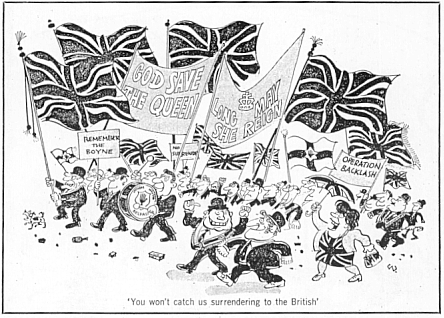
I attended an event at St Mary’s where a panel of three unionists, one being a former unionist senator, were invited to make a case for the union. The case they tried to make was at times banal, incoherent, bouncing around comparative welfare stats and seemingly having little understanding of the broader economic issues. The former senator’s ramblings did sound like an Ulster Unionist, in that you are sent away bemused rather than informed. There was little understanding of the failure of political unionism, not just in its lack of pluralism, but also in embedding a political culture in their communities that working-class Billy and working-class Seamus had nothing in common. This on top of failing to properly represent the needs and aspirations of working-class protestants in the post-agreement political landscape thus, undermining the development of working-class politics in their communities. Apologies, nearly forgot the monumental political blunder of supporting, Brexit. Two of the panellists made the point that unionism was not an identity, but a political ideology. I agree with the former, but an ideology it is not, especially if you believe that a political ideology spans a spectrum from left to right. I would describe it as a mindset, a mindset that has always felt under siege.
Today, the DUP (Death of the Union Party) and the TUV (Thoughtless Unionist Voice) continue to bang on about the Windsor Framework while voters here and across GB have pressing concerns, such as the cost-of-living crisis, foodbanks, inflation, mortgages, crumbling GP and healthcare services and the war in Ukraine. This continuing desire to engage in political self-harm is putting Northern Ireland’s current constitutional position at risk. As for Sein Fein, who are part of the failed political cabal at Stormont, silence seems like a political virtue and strategy.
Unionism has also failed to engage in the debate on Irish unification showing political weakness, not strength. They need to hold Republican’s feet to the fire about what’s going to be new in this “New Ireland “and whether it will create the political and economic utopia that Sinn Fein suggests. This engagement does not undermine a principled position to remain as part of the UK. Why, because the journey to Irish unification is not straightforward, with issues around the integration of public services, education, economic integration, healthcare, and a structure of government that ensures all parts of the new and expanded electorate have a voice and a stake. I believe, (call me a political optimist) if properly communicated to the unionist community, a robust engagement around Irish unification will not be seen as a Chamberlain-type capitulation but as real leadership, something that ordinary working-class unionists have been devoid of for years.
Whether you are making the case for the union or for that matter making the case for unification, one thing is clear and that is, making this place politically stable and economically viable is essential.
Finally, if this week’s event is the best case that can be made for the union, they think it’s all over, on this showing, it is now.
Suneil Sharma
10th August 2023
 The Gob
Leave a Reply