
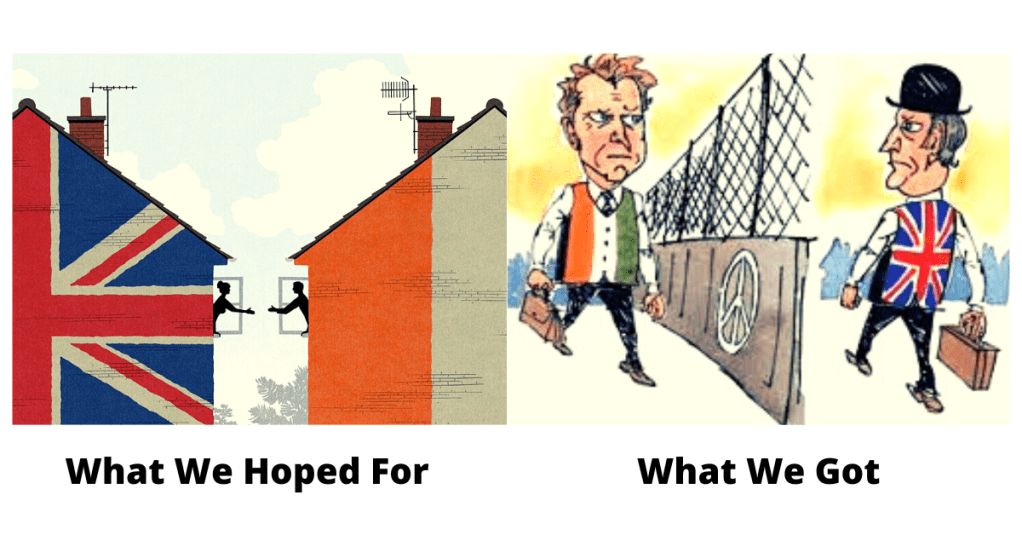
When the Belfast Agreement was signed in 1998, I was 39 and after 30 years of conflict, I saw for the first time being able to commit myself to build a future here. Then In August 1998 the Omagh Bomb, which in addition to destroying many lives, punctured hopes for a peaceful and prosperous future. Then we got over the last great hurdle, which was the decommissioning of paramilitary weapons, followed by a new and unlikely political bond between Ian Paisley and Martin McGuinness, later to be described as the Chuckle Brothers. This unlikely political partnership put a smile on many faces and brought renewed hope that a society riven by sectarianism could become a society built on common dreams and values. Then I woke up and had my cornflakes.
Firstly, as a political cynic and believe me, there is plenty to be cynical about, I recognise the Belfast Agreement brought about the end of violence and closed the book on violence as a tool for change. I and many others are grateful for that. It embedded the principle of consent in respect of Northern Ireland’s constitutional future and the principle of power-sharing as part of the new political dispensation. Important institutional reforms, notably in the form of the new Police Service of Northern Ireland, the Police Ombudsman, the Policing Board and the Human Rights Commission. Other bodies were set up, many of which today, are quite frankly of no value other than for those who circle the public appointments system like buzzards. On the issue of policing and as a member of the Policing Board from 2001, I would like to thank Hugh Orde for his commitment to implementing the Patton Commission reforms. In 2009 Martin McGuiness’s clear condemnation of violent/dissident republicanism after the murder of police officer Stephen Caroll and two soldiers Mark Quinsey and Patrick Azimkar. I was on the policing board at that time; for me, it was a high point in the peace process and for political leadership. Then there was a cordial meeting between the Queen and Martin McGuiness in 2012.
All good so far.
Eu and the UK spent billions of pounds on peacebuilding. This money went to everyone from Ex prisoner groups to a wide range of community groups involved in community development and capacity building, a new phrase in the rapidly expanding 3rd sector. The funds were also given to local actors (an interesting euphemism) to cultivate peace in civic society. Much of the money was handed out without any real evaluation criteria let alone clear measurable objectives or as we entrepreneurs call it, key performance indicators.
What is clear, is that if it took money in whatever amounts to embed and tie in all the protagonists to the conflict, so be it. A study by the University of Ulster called, The Story of Peace pointed out that “… some 50 per cent of all armed conflicts slip back into militarised violence within five years of signing a ‘peace’ agreement”. So, on that basis alone, it was well worth it.
As American president, Lyndon B Johnson said,” better to have them inside the tent pissing out rather than outside the tent pissing in”. So, in effect conflict was taken off the streets and into Stormont, under a power-sharing regime called a mandatory coalition. The term mandatory coalition is an oxymoron because a coalition is generally based on compromises in terms of objectives and public policy. Our coalition is more like an MMA contest with ridiculous procedures like a petition of concern designed into the system. For two communities and two political traditions where trust was in short supply, a mandatory coalition with inertia designed in, is as good as it gets.
The peace process, a largely political endeavour trundled on. What is clear now as it was then, is that if any capacity building is required, it is required by the public representatives we voted into Stormont and local government. This was highlighted by the scandal over RHI, for which no heads rolled. More recently Gordon Lyons’s crass piece of political populism where he handed out post covid £100 vouchers, a policy supported by the UUP, Alliance, the Social Democrat and Labour Party and our socialist friends in Sinn Fein.
This £150 million handout went to BT9’ers and the like, rather than to those “key workers” who worked tirelessly to support families during Covid. We as a community clapped every Thursday night for the dedication of these care workers who earn less than £9.00 per hour.
Dozens of bills have been passed, including financial assistance for political parties, high hedges, marriage equality, human trafficking, and many others. The point I am trying to make is that much of the legislation that has been passed would and could have been passed through direct rule anyway, so what has been the real added value of our venerated assembly? However, if peace is the only measure of success 25 years after the agreement was signed, well this looks like a mighty low bar. Political dysfunction has resulted in suspensions, which account for 35% of the assembly’s existence. According to the Guardian, of the 871 motions and amendments debated in the current assembly from 2000, only 51% had cross-community support. The anachronism known as the Petition of Concern has been tabled 160 times, this highlights the absurd tribalism built into the system. It was used by the DUP to scupper equal marriage proposals in 2015 and used to stop the sanctioning of MLAs for misconduct by the Commissioner for Standards. Things like this should give the electorate little confidence about the integrity of the political representatives they elect.
The economy is better with more FDA, though from a very low base and there are shiny new buildings and the development of the Titanic Quarter and the Cathedral Quarter. We still have an over-bloated public sector; public spending remains at almost 60% of GDP, productivity languishes in the lower divisions and according to the Northern Ireland Jobs Barometer our universities are firing out graduates but for the wrong sectors.
We still operate an apartheid education system (sustained by the pressure of a truly single constituency called the middle classes and the religious establishment) which is contrary and flies in the face of building the so-called shared future. Schools have become exam factories, no longer centres where you go and enjoy the acquisition of knowledge and acquire skills.
The Northern Ireland Skills Barometer report from the Department for the Economy and Ulster University’s Economic Policy Centre found that 30% of school leavers achieved less than five GCSE’s from A*-C including English and Maths. Climate science is not on the syllabus, booklets have replaced books, and students are not being taught how to navigate the complex information and disinformation ecosystem.
We continue to train teachers along sectarian grounds, and they then migrate to schools on the same basis in addition we are also depressingly short of good computer science teachers.
The assembly has failed and seems scared to address important health service reforms, and reform of the civil service, reform of local government let alone other failing institutions such as Invest Ni and the Housing Executive. We now seem to have a health service where some consultants enjoy the largesse of the private sector and where the public can wait weeks to get a GP appointment and months to see specialists. Local government is a shambles, run by past their sell-by date public servants. It is these public servants and their political masters that rubber stamp vanity projects like Belfast Stories at a cost of some £90 million but who have failed to address a planning system that has been deemed the worst in the UK and which directly impacts economic development, let alone the issues around the mind-blowing bureaucracy. A change to free prescription and domestic water charges could raise some £700m and even if you took steps to mitigate the impact on the most vulnerable individuals and groups, you could raise possibly £500M. Though the electorate must ask itself; do you want the” visionary’s” on the hill to have any more of your hard-earned income?
The legacy issue remains unresolved though the question must be asked, why do the DUP and SF agree on this, is it empathy with victims, I doubt it, is it a deep desire to see judicial justice, yet again over-promising and underdelivering. Could it be that the words amnesty and reconciliation are incompatible? We all favour a victim- and survivor-centred approach to the legacy, but what does that mean in terms of support and outcomes? In South Africa, Nelson Mandela knew he could not promise justice for the crimes committed by the apartheid regime. The Truth and Reconciliation Commission was set up to try and deliver a truth recovery process for victims and their families, including amnesty. Archbishop TuTu and his fellow commissioners could make that call if this meant amnesty for truth recovery. This process required political will, joint leadership, trust-building, accountability, and transparency, qualities few of our political establishment exhibit.
The current suspension over a Protocol, that Unionists naively signed up for after believing the proverbial BS’er Boris, tells me that Unionism is on a political ventilator and Unionists politicians, much like the past 50 years are failing their constituents, particularly their working-class constituents. Some of our politicians seem to have had a collective eureka moment after the rebuttal by the Supreme Court of the showboating case bought by some members of the Death of the Union Party and their conservative wing the Thoughtless Unionist Voice, about the constitutionality of the protocol.
Declan Kearney welcomed the judgement, adding the protocol was “imperfect” but “clearly necessary”.
“Following this judgment, it is now critical that the EU and UK negotiating teams reach a comprehensive resolution that protects our unique access to the Single Market for goods while addressing the concerns around protocol implementation that have given rise to sincere objections related to trade barriers and identity issues in the unionist community,” assembly member Matthew O’Toole said..”
Stephen Farry now wants to focus on pragmatic solutions whereas previously he wanted the protocol “vigorously implemented”.
Even your friend and ours Maros Sefcovic said that Protocol must work for all communities, praise the Lord. So, let us get the dam protocol sorted and that gives Jeffrey an off-ramp and gets those like Bryson off the platform that he should never have gotten in the first place. If working-class protestants have not yet realised that the greatest threat to them is not republicans, nationalists, Catholics or for that matter a border poll, but sadly like in the past, it is the quality and vision of their political leaders and representatives.
As Unionism marches on like a new-born giraffe, Republicanism is confident and on the rise. However, like Unionists, Sinn Fein resides in their echo chamber with Ireland’s Future jamborees that preach to the converted and are unchallenged about the substantive nature of its mantra, of a “New Ireland”.
The so-called middle ground parties particularly the SDLP and the UUP have in effect been gutted, unable to navigate the post-1998 political landscape. They have provided no vision, no real progressive public policy agenda and simply look like B-team versions of their DUP or Sein Fein brothers and sisters. The Alliance Party and its recent success is as a direct failure of both the UUP and the SDLP being unable to navigate the aforementioned political landscape. The Alliance Party has no political soul, a party you can paint with any political stripe or ideology and therefore has successfully become a party of all things to all people and a party of “it’s not my fault gov”.
I am genuinely grateful for the end of violence that the Belfast Agreement delivered but this is no way to govern in the 21st century. The New Decade New Approach failed to explain what decade and how can you possibly have a new approach with the same inmates running the asylum.
So, to all those attending the 25th-anniversary celebration and who contributed to the delivery of the agreement, your name is already etched in history. The debate around our future is not whether we maintain the Union or create a 32-county Ireland but whether we the electorate will continue to be lumbered with a dysfunctional political system and a political class that are unable to grasp the challenges of an ever-changing world, devoid of a vision let alone a plan. Finally, could a political system for which there are no consequences for political failure be called, a failed state?
Happy Easter Everyone
Let me know what you think in the comments below 👇
Suneil Sharma
20th February 2023
 The Gob
Leave a Reply